

CCTV laws in NSW: 14 days' notice and a $120 site survey
CCTV cameras are legal across New South Wales for most homes and businesses, but two Acts set strict limits on how you use them. The Surveillance Devices Act 2007 governs audio and visual recording generally, while the Workplace Surveillance Act 2005 adds notice and visibility rules for employers. Keep audio off, give workers 14 days' notice, and talk to neighbours before escalating. If you're facing a genuine safety threat, call police first.
Key takeaways
- CCTV cameras must avoid capturing private areas beyond your property, such as neighboring bedrooms or bathrooms, to prevent voyeurism offences.
- Employers must provide at least 14 days' written notice and ensure cameras are visible with signage; covert surveillance is only allowed with a magistrate's approval.
- Disabling microphones on CCTV systems significantly reduces legal risks related to audio recordings, which are treated more strictly under NSW law.
- Most home installations do not require council approval unless facing public areas or involving complex wiring; strata rules may also impose additional approvals.
- A professional site assessment from a qualified provider costs from $120 and ensures your CCTV setup complies with sightline, signage, and data storage requirements.
Table of Contents
- Which laws apply in NSW and what each covers
- How the Privacy Act differs from NSW surveillance law
- Private property and neighbours: when CCTV may be unlawful
- Workplace CCTV: notice, visibility, signage and covert surveillance rules
- Audio vs video: why audio recordings are more legally risky in NSW
- Planning, council rules and strata that affect CCTV installation
- What to do if you're affected by unlawful or intrusive CCTV
- PC Scientist: how a local NSW IT and CCTV specialist can help you comply
- Balancing security and privacy: an editorial note for NSW readers
- Getting a compliant CCTV setup sorted the easy way
- FAQ
- Sources
Which laws apply in NSW and what each covers
Three instruments do most of the work here. The Surveillance Devices Act 2007 makes it an offence to install, use or maintain an optical, listening or data surveillance device on premises or in a vehicle without consent, backed by fines and possible imprisonment.
The Workplace Surveillance Act 2005 sits alongside it for employers, requiring written notice before cameras, computer monitoring or tracking devices go live, and banning covert surveillance of staff without a magistrate's authority. The Privacy and Personal Information Protection Regulation 2019 fills in detail for government agencies handling CCTV data, covering how that information is stored and disclosed. Knowing which of these applies to your situation is the first step to getting it right.
How the Privacy Act differs from NSW surveillance law
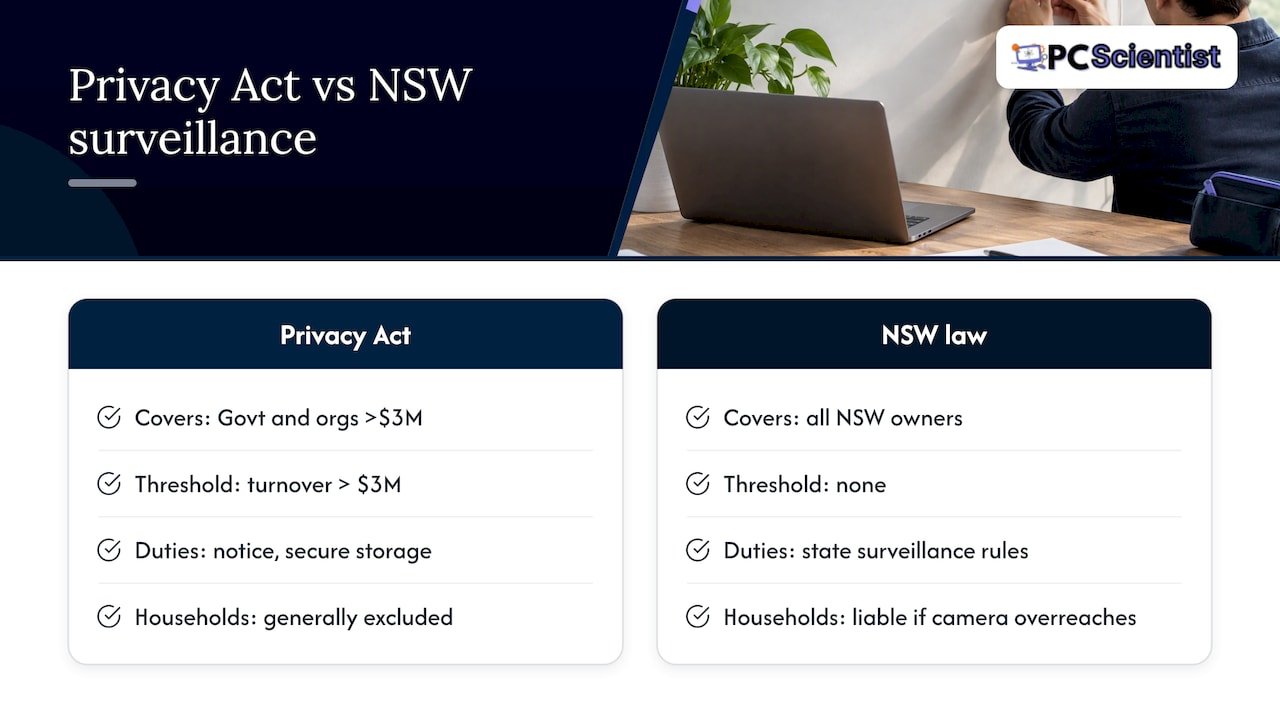
The federal Privacy Act 1988 only catches Australian Government agencies and organisations with annual turnover above $3 million, according to OAIC guidance on security cameras. If your business clears that threshold, you take on extra duties under the Australian Privacy Principles: telling people their footage is being collected, storing it securely, keeping it only as long as needed, and giving individuals access to footage of themselves on request.
Most households and small operators sit below that line, so the Privacy Act doesn't touch them directly. That doesn't mean a free pass: NSW surveillance law still applies in full, and a homeowner's camera can still land them in strife if it captures more than it should.
Private property and neighbours: when CCTV may be unlawful
A camera aimed at your own driveway is generally fine. One that captures a neighbour's bedroom window, bathroom, or backyard beyond what's needed for your own security is a different matter, and can tip into voyeurism offences under the Surveillance Devices Act. Audio is the bigger trap: recording a private conversation without consent is a separate offence from video capture, and carries its own penalties.
Before anything formal, OAIC guidance on neighbour disputes points to calm, direct conversation as the sensible first move, with state law and police reserved for serious matters.
- Start with a polite conversation about where the camera points.
- If that doesn't resolve it, try a community justice centre or mediation service.
- Raise it with strata or your local council if the camera sits on shared or regulated property.
- Contact police or get legal advice if you suspect a criminal offence or harassment.
Pro Tip: Photograph the camera's apparent sightline from your own yard before raising it with anyone, it's the clearest evidence of what it actually captures.
Workplace CCTV: notice, visibility, signage and covert surveillance rules
Employers get more scrutiny than homeowners, and for good reason: staff can't simply avoid a workplace camera the way a passer-by can avoid a shop window. The Workplace Surveillance Act 2005 sets out a clear sequence.
- Give employees at least 14 days' written notice before surveillance starts, covering the kind of surveillance, how it will be carried out, when it starts and whether it's continuous or intermittent.
- Make cameras clearly visible, with signage at entrances, as outlined in the IPC NSW short guide to the Workplace Surveillance Act.
- New employees need notice before or as soon as practicable after they start, never after surveillance has already begun unnoticed.
- Covert surveillance of staff is prohibited unless a magistrate issues a covert surveillance authority, usually tied to suspected unlawful activity.
Documented policies and visible cameras are persuasive evidence of good faith if a dispute ever reaches the Fair Work Commission or a court.
Audio vs video: why audio recordings are more legally risky in NSW
Video alone is the safer path. The Surveillance Devices Act treats listening devices as a distinct offence from optical surveillance, and workplace rules layer on top of that for staff conversations. Unless you have clear consent or a specific legal authority, the simplest fix is practical: disable microphones on your cameras, or choose systems that record vision only. It removes an entire category of legal risk for very little loss of security value.
Planning, council rules and strata that affect CCTV installation
Local councils rarely block a standard home camera, but larger developments or cameras facing public areas can attract planning conditions, and IPC NSW guidance on CCTV and private property notes that context changes the rules considerably. Strata buildings often go further: many by-laws require owners' corporation approval before you mount a camera on common property, even your own front door.
Before you install, check your strata by-laws, confirm whether your council has conditions for commercial or public-facing systems, and if the installation involves new wiring or power points, qualified electrical work such as that offered by High Demand Electrical Sydney may be required to meet safety standards.
What to do if you're affected by unlawful or intrusive CCTV
If a camera feels intrusive, work through the problem methodically rather than reacting immediately.
- Note dates, times and the camera's apparent field of view, but never record the neighbour's private conversations yourself.
- Raise it directly with the neighbour or, for shared buildings, with strata first.
- Use a community justice centre for mediation if a direct conversation doesn't help.
- Escalate to council for planning breaches, or to police where you suspect a criminal offence.
- Seek legal advice if you're considering a nuisance claim or injunction, since these routes carry real cost and take time.
Mediation remains the fastest realistic resolution in most neighbour disputes, well ahead of court action in both cost and speed.
PC Scientist: how a local NSW IT and CCTV specialist can help you comply
We handle the practical side of staying compliant: a documented site assessment, careful camera placement to respect privacy, audio disabled by default, and secure network storage for footage. A proper survey, through our Security Camera Scientist service, gives you sightline documentation and signage advice you can point to if anyone ever questions your setup.
Balancing security and privacy: an editorial note for NSW readers
We understand why people want cameras, and why neighbours worry about being watched. Visible, proportionate surveillance paired with an honest conversation beats a hidden one every time, and professional installation keeps both sides comfortable.
- PC Scientist
Getting a compliant CCTV setup sorted a clear way
We take the guesswork out of staying on the right side of NSW surveillance law. Our Business & Venue CCTV service covers homes and businesses across Sydney Metro, the Central Coast, Newcastle, Wollongong, the Southern Highlands and surrounding regions, with a site assessment fee from $120 one-off through Security Camera Scientist.

- We check sightlines so cameras cover your property without capturing a neighbour's windows or yard.
- We advise on signage placement that meets workplace and public-facing requirements.
- We configure secure, access-controlled storage for your footage.
Book a site assessment and we'll walk you through what a compliant setup looks like for your property.
Sources
Recommended
Frequently Asked Questions
Straight answers about Avoid fines: CCTV laws in NSW, 14 days' notice and $120 site survey - without jargon or pressure. Call 0493 563 381 for advice, or get help below.
Want the quickest answer? 0493 563 381 for free advice.
Yes, CCTV on private property is generally legal in NSW provided it doesn't capture areas like a neighbour's bedroom or bathroom without consent. The Surveillance Devices Act 2007 governs these limits, and audio recording without consent is treated as a separate, higher-risk offence.
NSW surveillance is governed mainly by the Surveillance Devices Act 2007 for general use and the Workplace Surveillance Act 2005 for employer monitoring. The Privacy and Personal Information Protection Regulation 2019 adds detail for how government agencies handle CCTV information.
Restrictions vary by state, but in NSW the core rules are consent for recording on someone else's property, no audio capture without consent, and specific notice and visibility obligations for workplace cameras. Organisations with turnover above $3 million also face Privacy Act obligations, according to OAIC guidance.
Most standard home CCTV installations don't need council approval, though larger developments or cameras facing public areas can attract planning conditions, per IPC NSW guidance. Strata properties often require owners' corporation approval separately from any council rule.
Our site assessment fee starts from $120 one-off through Security Camera Scientist, covering sightline checks, signage advice and placement planning. The exact scope depends on your property and the number of cameras involved.
CCTV help across NSW
Want to talk through CCTV laws in NSW?
If you would rather not plan cameras on your own, get help in your area. We will talk it through first.
Start here
Get CCTV help
Optional Need a Sydney city or region?
Choose a side of Sydney
These are Sydney cities and regions, such as the Northern Beaches or Inner West. First tap a side of Sydney. Then open the city or region that covers you.
C Sydney City / Inner 3 areas
N Northern Sydney 6 areas
NW North-West / Central Sydney 3 areas
W Western Sydney 1 area
SW South-West Sydney 3 areas
S Southern Sydney 2 areas
Optional Find your suburb
Type a suburb from our listed coverage. This opens the matching city or region page for this topic. Listed suburb pages are general technology services, not this specialist page.
If your suburb is not listed, use the city or region list above, or call 0493 563 381.
Disclaimer
The information in this article is provided for general educational and informational purposes only. While PC Scientist strives to keep all content accurate and up to date, technology issues can vary depending on your device, software, network configuration, and individual circumstances. Always back up important data before attempting repairs or system changes. If you are unsure or the issue cannot be resolved safely, contact PC Scientist today for professional onsite or remote IT support. PC Scientist is not liable for any loss of data, damage, or other issues resulting from the use of the information provided in this article.
