

Sydney CCTV installation costs: NSW licence rules and $120 site survey example
Most Sydney homeowners can expect to pay a few thousand dollars for a basic four-camera system, while small businesses and commercial sites typically budget several thousand dollars depending on camera count and resolution, according to Australian market pricing for 2026. Where you land in that range depends on camera quality, wired versus wireless setup, storage needs, and how much electrical work your property requires.
Key takeaways
- A four-camera home system in Sydney generally costs between a few thousand dollars, depending on camera quality and electrical work needed.
- Small business packages with four higher-resolution cameras often range from $2,200 to $5,300, while larger commercial systems with eight cameras typically cost $5,000 to $9,000.
- Wiring type influences cost, with wired PoE systems being more reliable but more labor-intensive, whereas wireless setups reduce installation time but depend on Wi-Fi strength.
- Licensing requirements in NSW mandate licensed electricians and security installers, making unlicensed work illegal and risky for insurance coverage.
- Accurate quotes require a site survey that considers camera placement, electrical access, and storage needs, with separate line items for supply, labor, and electrical work.
Table of Contents
- Costs at a glance: per-camera bands and three example packages
- What affects the price: camera, system and installation components
- Residential vs commercial quotes: side by side examples
- Wiring, electrical work and NSW licensing you must budget for
- How to get an accurate quote: checklist and questions to ask installers
- PC Scientist: site survey and install workflow (practical NSW example)
- Cost-saving options, realistic DIY approaches and when to hire a pro
- PC Scientist perspective: prioritise placement, compliance and realistic retention
- How PC Scientist helps: service snapshot and next step
- Sources
- FAQ
Costs at a glance: per-camera bands and three example packages
Camera pricing in Sydney splits roughly into three tiers. Entry-level IP cameras (basic resolution, limited night vision) tend to sit at the lower end of the market. Mid-range cameras with better low-light performance and wider lenses cost more per unit, and high-end options like pan-tilt-zoom (PTZ) cameras or those built for harsh weather sit at the top.
Rather than guess at individual camera prices, it helps to look at complete packages, since installers quote by system, not by camera alone.
- 4-camera home system: covers a typical suburban house exterior (front door, driveway, back yard, side access), including a basic recorder and cabling.
- 4-camera small business system: usually specifies higher resolution and wider dynamic range for identifying faces or number plates, plus a recorder with longer retention.
- 8-camera commercial system: covers larger premises like a warehouse, retail strip or medical clinic, with a commercial-grade recorder and often a monitoring add-on.
A four-camera small business package commonly runs $2,200 to $5,300, while an eight-camera high-resolution commercial system typically costs $5,000 to $9,000 installed, according to commercial security cost data for Australia. Commercial-grade IP camera installations generally cost several hundred to a bit over a thousand dollars per camera once you include labour and the recorder.
If you're adding cloud storage or professional monitoring, expect an ongoing monthly fee on top of the installation cost. Monitored systems and cloud backup plans vary between providers, so it's worth asking installers to quote the recurring cost separately from the one-off install so you can compare like for like.
What affects the price: camera, system and installation components
Every CCTV quote breaks down into a handful of cost drivers. Understanding them means you can spot whether a quote is genuinely competitive or just missing something.
Camera specifications move the price more than anything else. Resolution (measured in megapixels), infrared night vision range, lens type (fixed versus varifocal) and weatherproof ratings all add cost as you go up the range. A PTZ camera that can pan and zoom remotely costs meaningfully more than a fixed camera, and installers usually charge more for the mounting bracket and cabling that come with it.
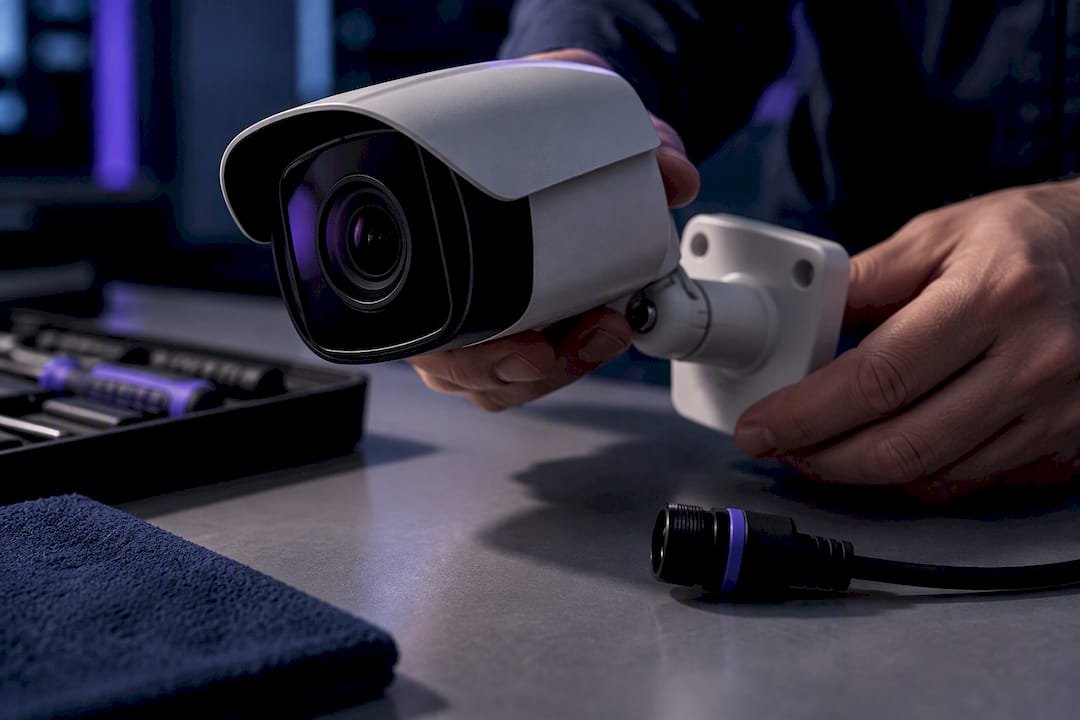
Wired versus wireless is the next big fork in the road. Power over Ethernet (PoE) systems run a single cable for both power and data, which tends to be more reliable and easier to maintain long-term, but the cabling itself adds labour cost, especially in older homes with brick or concrete walls. Wireless systems cut installation time and cabling cost but rely on Wi-Fi signal strength and battery life, which can mean compromises on camera placement. A comparison of wired and wireless CCTV is worth reading before you commit either way.
Recorder and storage choices affect both the upfront price and how much footage you can keep. A network video recorder (NVR) needs to be sized to your camera count, resolution and how many days you want to retain footage. More cameras at higher resolution eat storage fast, so a business wanting 30 days of retention across eight high-resolution cameras needs a bigger, pricier NVR than a home wanting a week of footage from four cameras.
Installation complexity is where quotes diverge the most for otherwise similar systems. Roof access, cavity walls, long cable runs between floors, and cameras mounted at height all add labour hours. A single-storey home with easy roof access is straightforward; a two-storey terrace with no roof cavity access can add real time and cost to the same camera count.
- Electrical and switchboard work: needed when a recorder requires a new power point or when cabling has to run through walls near existing wiring.
- GST: applies to the full invoice as with any registered trade service in Australia.
- Permits: generally not required for standard residential or commercial CCTV, but strata or heritage-listed properties sometimes have their own rules worth checking before installation day.
Pro tip: Ask installers to quote supply, labour and any electrical work as separate line items. It makes comparing two quotes far easier, and it flags upfront whether electrical work is included or billed separately.
Residential vs commercial quotes: side by side examples
The same camera count can produce very different quotes depending on what the site actually needs. A four-camera system for a home and a four-camera system for a business rarely cost the same, even though the camera count matches.
- 4-camera home: typically covers entry points and a driveway, uses mid-range cameras, and includes a basic recorder with a week or two of storage, landing in the lower part of the residential range.
- 4-camera small business: usually needs higher resolution for identifying faces or vehicle plates, a recorder with longer retention for insurance and dispute purposes, and sometimes a monitoring add-on, which pushes the price toward $2,200 to $5,300 as noted above.
- 8-camera commercial: adds a commercial-grade recorder, wider coverage across a larger site, and frequently integrates with access control or existing alarm systems, landing in the $5,000 to $9,000 band for higher-resolution setups.
The pattern that matters here: commercial pricing tracks system grade, not just hardware count. A recorder capable of longer retention, remote access for multiple staff, and integration with other security systems costs more regardless of how many cameras are attached to it. Upgrading a handful of cameras to a higher resolution can push up the cost of the recorder and storage disproportionately, according to the same commercial security pricing data, because higher-resolution footage takes up more storage and needs more processing power to manage.
If you're planning a commercial fit-out alongside a CCTV install, it's worth coordinating the two. Managing an office fit-out involves electrical and cabling decisions that overlap directly with security camera planning, so raising CCTV early in that process avoids doubling up on cabling work later.
Wiring, electrical work and NSW licensing you must budget for
This is the part of CCTV pricing that catches people out, because it's not really about the cameras at all. It's about who is legally allowed to do the work.
In NSW, any electrical wiring work, including running new cable to power a recorder or connecting into a switchboard, must be carried out by a licensed electrician, regardless of the property type or the size of the job, according to the NSW Government's electrical licensing guidance. This isn't a formality you can skip to save money. It's a legal requirement, and it affects your insurance too.
Separately, installing, repairing or servicing security equipment for a fee in NSW is a regulated activity under the Security Industry Act, which means the installer needs a security licence, and individual technicians typically need a Class 2C security equipment specialist licence, according to NSW Police. This is separate from the electrical licence, and a proper installer will hold both credentials or coordinate with someone who does.
- Ask for licence numbers upfront and check them against the relevant regulator before booking.
- Confirm which parts of the job need an electrician versus a security technician, since they're different trades with different licences.
- Understand the insurance risk: unlicensed electrical or security work can void your home or business insurance and may attract fines under the Security Industry Act.
Licensed installation isn't optional in NSW, it's a legal requirement that also protects your insurance cover. Skipping it to save a few hundred dollars on the quote can cost far more if something goes wrong later.
How to get an accurate quote: checklist and questions to ask installers
A comparable, trustworthy quote takes a bit of upfront legwork, but it saves you from surprise costs later. Here's the order to work through it in.
- Request a site survey before accepting any quote, since camera placement, cable runs and access all affect the final price.
- Ask for an itemised written quote that separates camera supply, labour, recorder and storage, and any electrical work.
- Check licence numbers for both the security licence (Class 2C) and any electrician involved, and verify them on the relevant Service NSW portal.
- Ask about insurances and references, particularly for commercial jobs where liability matters more.
- Clarify recorder size and retention days, and confirm whether remote viewing on your phone is included or an extra cost.
- Ask about warranty and aftercare, including who you call if a camera fails six months in.
- Confirm who handles electrical work and whether it's included in the quoted price or billed separately.
- Ask about testing and commissioning, meaning the installer checks every camera's field of view and recording quality before calling the job done.
Pro tip: If a quote comes in noticeably lower than everyone else's, ask exactly what's excluded before you sign. Missing electrical work or a smaller-than-expected recorder are the two most common reasons for a suspiciously low number.
Camera placement also affects value for money more than most people expect. A guide to where cameras should go on your property is worth reviewing before your site survey, so you can flag priority areas and get a quote that actually matches what you need covered.
PC Scientist: site survey and install workflow (practical NSW example)
A proper site survey is where an accurate CCTV quote actually starts, and it's a step worth insisting on regardless of who you hire. At PC Scientist, a typical security camera site survey covers a coverage map of the property, planned cable routes, a check of existing power points and switchboard capacity, and sizing the recorder to match camera count, resolution and how many days of footage you want to keep.
That level of detail matters because it's what prevents change orders once the install is underway. A site assessment fee, listed from $120 one-off on the Security Camera Scientist page, buys a fixed, itemised quote rather than a rough estimate that might shift once the installer discovers a cavity wall or an undersized switchboard.
Where electrical work is needed, the installer coordinates with licensed electricians so the wiring side of the job meets NSW requirements without you having to source a separate trade yourself. Warranty terms and aftercare are part of the quote from the start, so if a camera develops a fault later, there's a clear path to get it fixed rather than starting from scratch with a new installer. For businesses managing multiple sites or wanting CCTV integrated with broader security planning, the business and venue CCTV service extends the same survey-first approach to commercial premises across NSW.
Cost-saving options, realistic DIY approaches and when to hire a pro
There are genuine ways to bring the cost down without cutting corners on compliance or coverage.
- Phase the install: cover your highest-priority areas first (front door, driveway) and add cameras later rather than paying for an eight-camera system on day one.
- Reuse existing cabling where a property already has data or coaxial cable runs in useful locations, which can cut labour hours significantly.
- Choose a lower retention plan: fewer days of stored footage means a smaller, cheaper recorder or a cheaper cloud storage tier.
Where DIY genuinely makes sense is limited. Mounting a battery-powered wireless camera yourself and connecting it to Wi-Fi is reasonable for a single camera covering a front door. Testing from CHOICE suggests mid-range wireless consumer cameras often offer solid value for simple residential monitoring, though budget models under $100 generally won't hold up for serious property security.
What DIY can't cover is anything involving wiring into your switchboard or running new electrical cable, since that legally requires a licensed electrician in NSW regardless of your confidence with a drill. Skipping that requirement risks voiding your insurance and can leave you non-compliant if anything goes wrong.
Hiring a professional makes the most sense for commercial venues, multi-storey homes with tricky access, systems that need to integrate with access control or alarms, and any site where getting coverage wrong has real consequences, like a warehouse or a medical clinic. For a straightforward single-camera setup on a ground-floor home, DIY wireless is a fair option. For anything more complex, the labour saved rarely outweighs the risk of a poorly placed camera or non-compliant wiring.
PC Scientist perspective: prioritise placement, compliance and realistic retention
The temptation with CCTV is to chase the cheapest camera hardware, but that's rarely where the money actually goes wrong. A brilliant camera pointed at the wrong angle, or a system wired outside NSW electrical rules, costs you more in the long run than spending a bit more upfront on correct placement and licensed installation.
Budget some contingency, not because installers are trying to catch you out, but because older Sydney properties in particular often reveal a cavity wall, an undersized switchboard or an awkward cable run once work starts. That contingency is cheaper than a mid-job renegotiation.
If there's one habit worth adopting before you sign anything, it's insisting on a proper site survey. It turns a rough estimate into a fixed, comparable quote, and it's the single best protection against paying for a system that doesn't actually cover what you need it to.
- PC Scientist
How PC Scientist helps: service snapshot and next step
Getting CCTV right in Sydney comes down to three things: a system sized correctly for your property, licensed installation that protects your insurance, and a quote you can actually trust before work starts. That's the gap Security Camera Scientist is built to close.

Every quote ideally starts with a site survey, itemising camera supply, labour and any electrical work separately, so you know what you're paying for and why. Where wiring is needed, licensed electricians should be coordinated as part of the job rather than leaving you to find one yourself, and warranty terms should be set out upfront rather than left as a grey area if something needs fixing later.
If you're weighing up a residential system or planning coverage for a commercial site, book a site assessment through Security Camera Scientist and get a fixed, comparable quote before you commit to anything.
Sources
Before hiring anyone, it's worth checking the primary sources yourself rather than taking an installer's word for it. NSW Police sets out the Class 2C and master licence rules for security equipment specialists, while the NSW Government confirms electrical licensing requirements through Service NSW.
If your system involves facial recognition or advanced analytics, the OAIC's statement on the Bunnings decision is worth reading, since biometric surveillance carries a high compliance bar in Australia. Cost bands referenced throughout this guide come from commercial security pricing data for Australia in 2026.
- Class 2C security equipment specialist | NSW Police Force
- Electrical work | NSW Government
- Commercial security cost Australia 2026 | WhatsTheDamage
Recommended
Frequently Asked Questions
Straight answers about Sydney CCTV installation costs: NSW licence rules and $120 site survey example - without jargon or pressure. Call 0493 563 381 for advice, or get help below.
Want the quickest answer? 0493 563 381 for free advice.
Most Sydney homeowners can expect to pay a few thousand dollars for a basic four-camera system, while small businesses and commercial sites typically budget several thousand dollars depending on camera resolution and recorder specifications, according to Australian pricing data for 2026. The exact figure depends heavily on wired versus wireless choice and how much electrical work your property needs.
A four-camera home system typically sits toward the lower end of the residential range, while a four-camera small business system with higher resolution and longer retention commonly costs $2,200 to $5,300 installed, according to the same commercial pricing data. The gap comes down to camera quality and recorder capability, not the camera count itself.
Installation cost depends on camera count, resolution, whether the system is wired or wireless, and how much cabling or electrical work the property needs. A site survey is the most reliable way to get an accurate figure for your specific property rather than relying on a generic estimate.
CCTV help across NSW
Still stuck working out CCTV installation cost?
If you would rather not plan cameras on your own, get help in your area. We will talk it through first.
Start here
Get CCTV help
Optional Need a Sydney city or region?
Choose a side of Sydney
These are Sydney cities and regions, such as the Northern Beaches or Inner West. First tap a side of Sydney. Then open the city or region that covers you.
C Sydney City / Inner 3 areas
N Northern Sydney 6 areas
NW North-West / Central Sydney 3 areas
W Western Sydney 1 area
SW South-West Sydney 3 areas
S Southern Sydney 2 areas
Optional Find your suburb
Type a suburb from our listed coverage. This opens the matching city or region page for this topic. Listed suburb pages are general technology services, not this specialist page.
If your suburb is not listed, use the city or region list above, or call 0493 563 381.
Disclaimer
The information in this article is provided for general educational and informational purposes only. While PC Scientist strives to keep all content accurate and up to date, technology issues can vary depending on your device, software, network configuration, and individual circumstances. Always back up important data before attempting repairs or system changes. If you are unsure or the issue cannot be resolved safely, contact PC Scientist today for professional onsite or remote IT support. PC Scientist is not liable for any loss of data, damage, or other issues resulting from the use of the information provided in this article.